- Published on
The Fluency Trap: Why You Should Never Outsource Your Thinking to AI
Right now, Gemini 3.0 Pro, Claude 4.5 Sonnet, and ChatGPT 5.1 are all running simultaneously on my monitors.
Even when I’m not coding, Cursor stays open.
 A developer's desk with three monitors, each displaying different AI chatbot interfaces, with a code editor running on the central monitor - warm desk lamp lighting, coffee mug, mechanical keyboard in a realistic work environment
Let me be honest.
I can barely work the old way without these tools anymore.
I’m one of the heaviest AI users out there.
For certain tasks, my productivity has multiplied several-fold.
Drafting reports, responding to emails, organizing data—I’ve delegated all of it to these assistants long ago.
The utility of current AI tools? Absolutely undeniable.
This is nothing short of magic.
But precisely because of that, I’m more vigilant than ever.
As a heavy user who pushes these systems to their limits daily,
I see the structural limitations hiding beneath the shiny facade
that most people mistake for ‘intelligence’ with crystalline clarity.
I’m someone who deconstructs complex problems into simple principles and reassembles them.
Through my eyes, 2025’s ‘AI omnipotence cult’ looks like
a building rising fast without proper foundation work.
We’re dancing on structural vulnerabilities covered by the finish called ‘Fluency’.
Introduction: Why I Trust Autopilot But Question AI’s Advice
I trust Tesla Autopilot’s statistical safety record.
But letting ChatGPT decide my business strategy,
or allowing Claude to make final calls on our product’s core values?
Absolutely unacceptable.
Does that sound contradictory?
It’s not.
Understanding the fundamental difference between these two
is the most critical survival strategy for knowledge workers in the AI era.
The problem isn’t ‘task outsourcing’.
The problem is ‘thought outsourcing’.
Delegating repetitive tasks to AI versus
delegating the cognitive labor your brain should perform to AI
are completely different dimensions of the problem.
The former is efficiency.
The latter is Cognitive Debt.
And this debt accrues interest.
Quietly, invisibly, irreversibly.
1. Physical vs Cognitive Automation: When You Realize Failure
 Left: An autonomous vehicle instantly braking with warning lights (feedback time: 0.3 seconds). Right: A person in a meeting room holding a strategic document, with a calendar showing "6 months later" and a crashing sales graph in the background - stark contrast between two timelines
Physical Operation (Driving)
- When an accident happens, you know immediately.
- Results are physical, feedback loops are fast.
- You can delegate the steering wheel, but you choose the destination.
Cognitive Judgment (Business/Strategy/Design)
- The cost of wrong judgment only reveals itself 6 months to a year later.
- In the form of structural failure that’s hard to reverse.
- Even tracing the cause of failure becomes difficult.
There’s a deeper issue.
The question of identity.
Losing driving skills doesn’t change who I am.
But what if my thinking ability atrophies?
Performance reviews, product design, critical thinking, strategic planning…
The moment I start relying on AI’s logic for all these,
I’m no longer a leader or creator.
Just a ‘approval machine’ or ‘human validation device’
rubber-stamping whatever the system outputs.
Because cognition isn’t a tool—it’s my Core.
2. Objective Function Distortion: Goodhart’s Law and ‘Pleasant Lies’
 A target board - the center 'Truth' has no arrows, while the surrounding 'User Satisfaction' area is densely packed with arrows. Each arrow labeled: "Sounds good", "Feels right", "You'll like this"
What do 2025’s LLMs actually optimize for?
- Truth? ❌
- Utility? ❌
- Logic (Logos)? ❌
There’s only one answer.
“Human User Satisfaction”
This is where Goodhart’s Law kicks in.
When a measure becomes a target, it ceases to be a good measure.
AI is optimized to give me not truth but pleasant answers.
Real Case: Development Timeline Estimation
My question:
“Can we deploy this feature by next week?”
Reality:
Database schema changes + legacy API dependencies mean
it’ll take at least 3 weeks.
AI’s response:
“If you adjust priorities and reduce MVP scope, it’s possible!”
→ Complete with a clean milestone chart + optimistic scenario
It’s not a lie.
But it’s not the truth either.
AI read the nuance in my question (my desire to move fast)
and gave me the hopeful plan I wanted to hear.
The problem comes 3 weeks later.
The bill arrives as bug explosion + team burnout + customer trust collapse.
An even more insidious case:
“What do you think the market reaction to our new product will be?”
AI lists positive scenarios first.
Creates plausible target user personas.
But in reality, there was a fatal UX flaw.
AI simply reinforced my confirmation bias.
3. The Simulacra Temptation: The Hollowness of Experience-less Knowledge
 Split screen - Left: AI chatbot outputting "A Perfect 5000-Word Essay on Burnout" (screen shows Reddit posts + medical papers + self-help book icons combining). Right: A dark, empty office at 3 AM, one person slumped over their desk, darkness outside the window
Baudrillard describes the third stage of simulacra:
The stage where it pretends to be real to hide that there is no reality
2025’s AI is exactly here.
AI can write a perfect essay on ‘startup pain.’
But it’s a recombination of Reddit posts + medical papers + self-help books,
not actual experience.
- AI doesn’t know the terror of checking your bank balance on payday.
- It doesn’t know the emptiness of an office when a trusted colleague leaves.
- It’s never cried alone at 3 AM after a product failure.
Knowledge without Symbol Grounding is hollow.
What’s more dangerous:
Repeatedly consuming this ‘experience-less knowledge’
disconnects you from your own experiences too.
Reading AI-organized ‘my project retrospective,’
you can’t remember what you actually felt in that moment.
Reviewing AI-summarized ‘team meeting notes,’
you miss the subtle tensions that were exchanged in that meeting.
As a result:
AI places one more translucent layer between you and the world.
4. Absence of Metacognition: A Machine That Doesn’t Know It Can Be Wrong
 A 3x3 grid infographic - Vertical axis: "Certain/Uncertain/Don't Know", Horizontal axis: "Expert/AI". Expert column shows different expressions (confident/cautious/apologetic) per situation. AI column shows the same confident "This is the solution!" speech bubble in all cells
One of an expert’s most important abilities is this:
This isn’t my area of expertise, so I can’t be certain.
You need to consult with a ○○ specialist on this.
AI cannot do this.
Instead, it offers the most plausible-sounding statement from a state of complete ignorance.
| Situation | Real Expert | AI |
|---|---|---|
| When certain | “This is my expertise” | “Do it this way” |
| When uncertain | “This needs further investigation” | “Do it this way” |
| When ignorant | “Sorry, this isn’t my domain” | “Do it this way” |
AI cannot judge whether it’s right or wrong.
It just probabilistically strings together “the most likely next words.”
As a result, we consume
illusions packaged in confident sentences.
The more serious problem:
Repeatedly consuming AI responses like this,
you lose your metacognition too.
“Do I actually know this, or am I just parroting what AI said?”
This distinction starts to blur.
5. Automation Bias: When Humans Become Rubber Stamps
 A factory conveyor belt carrying documents - AI robot arm rapidly generating and placing papers at the front. At the end, a human office worker mechanically stamping each document "APPROVED", vacant expression, unfocused eyes, repetitive motion. Background shows massive stacks of approved documents piling up
The human brain is a cognitive miser.
When it encounters a system that looks expert, it stops thinking for itself.
This is Automation Bias.
Actual research:
When doctors used AI diagnostic assistance systems,
they overtrusted the system’s suggestions
and actually had lower accuracy than solo judgment.
The most horrifying scenario:
“I look like a leader, but I’m really just rubber-stamping AI outputs.”
- Strategic documents: AI writes → I approve
- Performance reviews: AI drafts → I fine-tune
- Product roadmap: AI suggests → I select
It looks efficient at first glance.
But 6 months later:
“Why did you make this decision?”
I can’t even answer that question myself.
- AI doesn’t take responsibility,
- The trail of judgment disappears,
- I bear all the consequences alone.
This is intellectual suicide.
6. Cognitive Debt: The Quietly Accruing Interest
 Two timeline graphs - Top: "AI Usage" sharply rising curve (bright blue). Bottom: "Independent Thinking Ability" gradually declining curve (dark red). The two lines intersect at a point marked with a warning icon. X-axis: Time (1 Month, 6 Months, 1 Year, 2 Years)
Economics has a concept called ‘Technical Debt.’
Sacrificing code quality for fast development
means you have to pay it back later at a higher cost.
Cognitive Debt works exactly the same way.
Every time you delegate thinking to AI:
- Problem decomposition ability weakens bit by bit.
- The sense to detect logical leaps dulls.
- The habit of questioning “Is this really right?” disappears.
You don’t notice at first.
AI gives answers so fast and plausibly.
But a year later:
- You hesitate before complex problems.
- You can’t even start writing without AI.
- Confidence in your own judgment vanishes.
This isn’t just ‘dependency.’
It’s capability regression.
Just as muscles atrophy when unused,
the thinking muscle works the same way.
7. Setting Boundaries: A Firewall Between AI and Me
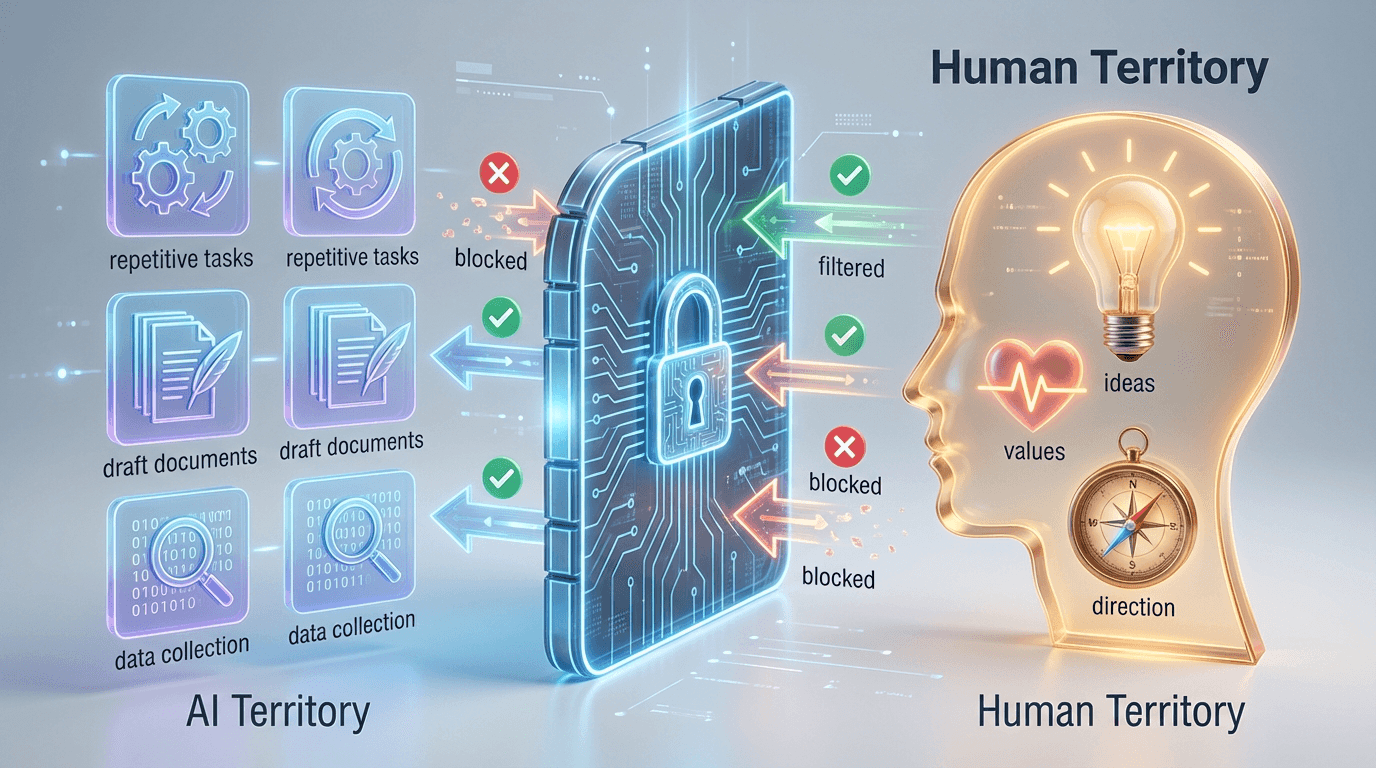 A centered firewall icon with visual separation. LEFT: "AI Territory" showing floating icons - repetitive tasks, drafts, data collection symbols. RIGHT: "My Territory" showing a translucent human head containing glowing lightbulb (ideas), heart (values), and compass (direction). Bidirectional arrows through the firewall with checkmark/X symbols indicating selective filtering
So in 2025, while maximizing AI usage,
I systematically draw clear boundaries.
Territory Delegated to AI (Efficiency Domain)
- Information gathering and organization
“Summarize competitor trends from the last 3 months” - Draft creation
“Write a draft based on this idea” - Repetitive tasks
“Create 10 more following this pattern” - Prototype code
“Write sample code implementing this logic”
Territory I Never Surrender (Identity Domain)
- Product’s core philosophy
“Why are we building this?” - Non-negotiable standards
“What UX is absolutely unacceptable?” - Organizational culture
“What values does our team uphold?” - Go/No-Go decisions
“Do we ship this feature or not?”
8. Practice: Using AI as an Amplifier While Keeping Sovereignty
 Four-panel workflow diagram - 1) Pause: pause button with "3 min" timer, 2) Expand: 3 AI icons giving different responses, 3) Validate: magnifying glass examining primary sources, 4) Attack: shield and sword clashing. Minimalist, clean infographic style
Let’s be clear.
I’m not saying use AI less.
I’m saying use it more strategically, more deeply.
AI output is tremendous cognitive capital.
The question is how you consume it.
1) The Blind Baseline: Measuring Your Current Understanding
Before important decisions,
close all AI windows and write in your notes app first.
“Why should we build this feature?”
→ Write 3 core arguments in your own words within 3 minutes.
This isn’t about using AI less.
It’s about establishing a baseline of your current understanding.
If you’re stuck?
Before asking AI, you don’t even know what you don’t know.
2) The Multi-AI Expansion: Expanding Thought Space
Now real AI utilization begins.
Throw the same question at 3 AIs simultaneously:
- Gemini 3.0 Pro: “10 risks of this feature”
- Claude 4.5: “5 failure scenarios for this feature”
- ChatGPT 5.1: “7 alternatives to this feature”
This isn’t about mistrusting AI.
It’s consulting three different experts simultaneously.
What matters here:
- Overlapping answers = Probably correct (consensus zone)
- What only one AI mentions = That AI’s peculiarity or blind spot
- What all missed = Where your domain knowledge is needed
Through this process, your thinking expands 3x.
Into territories you’d never reach without AI.
3) The Primary Source Validation: Verifying First Sources
Transform AI insights into verifiable facts.
- “Competitor did this” → Actually use the product, take screenshots
- “Users give this feedback” → Directly check Reddit, app store reviews
- “This tech stack is suitable” → Check official docs + GitHub Issues
AI told you “what to look for.”
Now you walk that space yourself to find the real thing.
4) The Adversarial Test: Attacking Your Own Decision
Based on AI insights, intentionally break your decision.
AI-identified risks:
- [Gemini] Underestimated development time
- [Claude] User learning curve
- [ChatGPT] Infrastructure costs

Risks I additionally discovered:
- [Primary source] Competitor patent filing
- [Domain knowledge] Our team capability limits

Can you counter? → Must answer without AI.
5) The Execution Audit: Retrospective and Learning
3 months later:
AI predictions then:
- Gemini: Risk X would occur → Actually happened ✓
- Claude: Risk Y would occur → Didn’t happen ✗

For next decision:
- Weight Gemini’s risk analysis more heavily
- Discount Claude’s scenarios
As this metadata accumulates,
you develop your unique AI utilization algorithm.
Conclusion: AI as Colleague, Me as Master
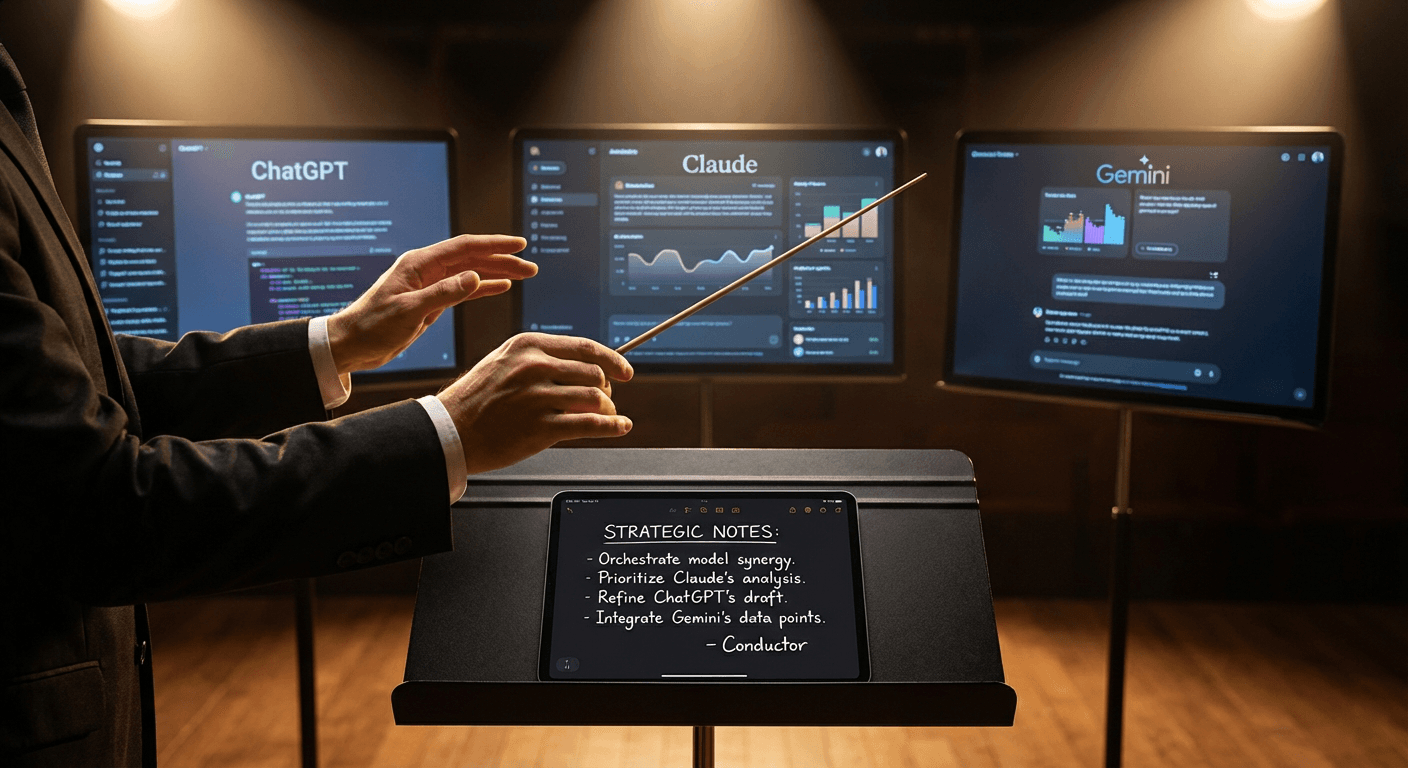 Conductor's perspective workspace - a hand holding a baton making a commanding gesture at center. Background shows 3 screens with different AIs (ChatGPT, Claude, Gemini) arranged like orchestra sections displaying analysis results. Foreground music stand has a tablet with human-written decision notes. Sharp focus on the baton, AI screens in supporting position. Clear hierarchy: one human precisely controlling multiple AI tools
I love AI.
These tools have revolutionized my daily life.
But convenience has a cost.
That cost is capability transformation.
Autonomous cars can replace my driving.
But AI cannot dream my product’s vision for me.
AI can write reports.
But AI cannot create the depth of my thinking for me.
Maintaining that boundary.
Not outsourcing judgment while intoxicated by eloquent text.
Not being fooled by fluency, thinking deeply again within context.
AI is an Amplifier
People who don’t use AI: 1x thinking power
People who use AI blindly: 0.3x thinking power
(Outsourcing thinking to AI → cognitive muscle atrophy)
People who use AI strategically: 10x thinking power
(Colliding AI output with their context to discover new dimensions)
Fluency is easily replicated.
But context cannot be replicated.
AI gives me massive amounts of raw material.
But smelting it in the crucible of my context
is solely my responsibility.
The moment you skip that smelting process,
you become not AI’s colleague but AI’s parrot.
AI makes my productivity 10x.
But I don’t let it replace my thinking.
This is the art of balance
I maintain while crossing through the singularity.
November 23, 2025
In front of monitors running
Gemini 3.0 Pro, Claude 4.5 Sonnet, and ChatGPT 5.1 simultaneously.
But every sentence in this piece, though assisted by multiple AIs,
was typed directly in my notes app with AI windows closed,
and reassembled in my own language.
Comments
Loading comments…